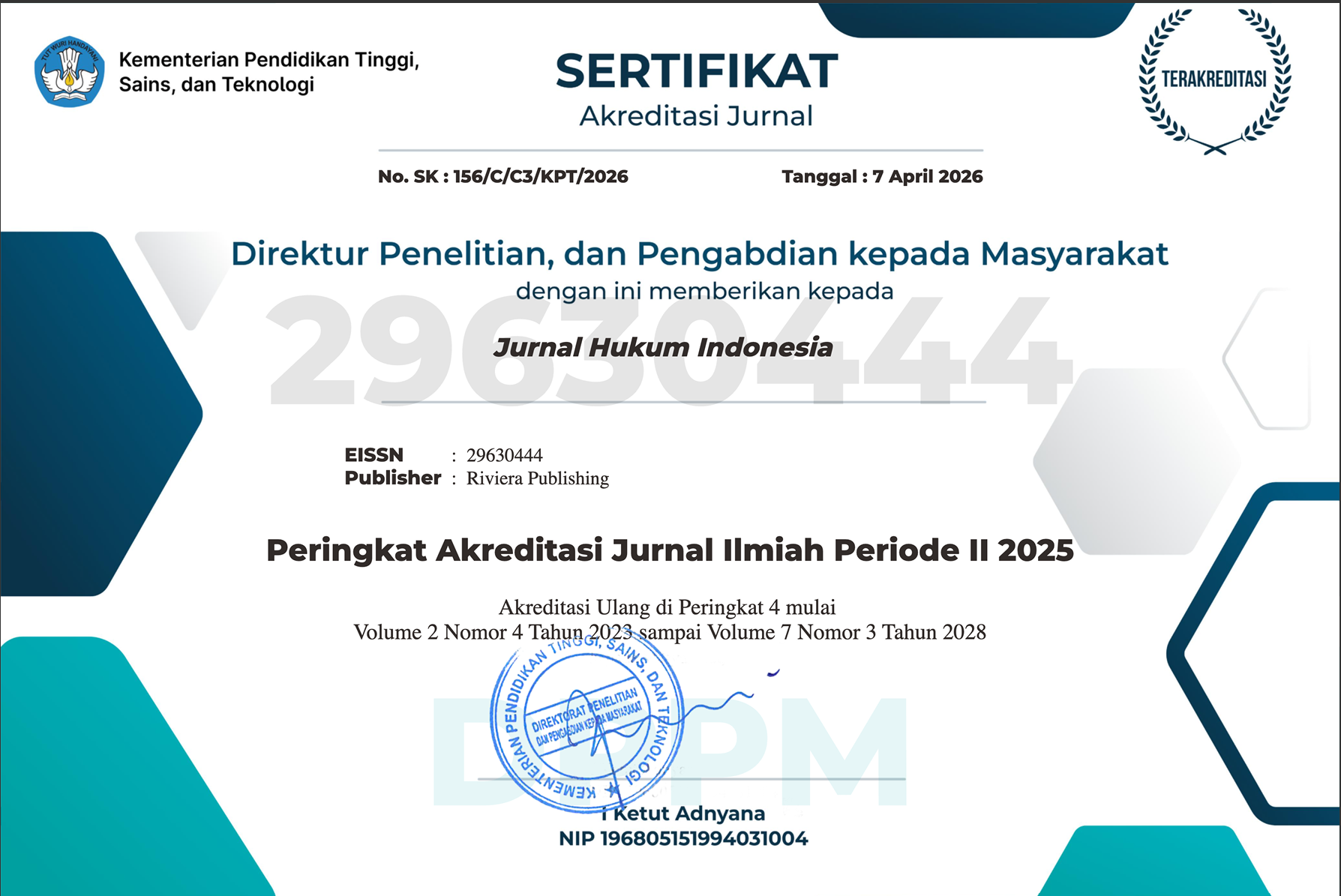
The Professionalism of the Indonesian National Police in Addressing Gang related Disturbances in Traditional Markets Within the Jurisdiction of Bogor Regency
Downloads
This study examines the professionalism of the Indonesian National Police in handling thuggery disturbances in traditional markets within the jurisdiction of Bogor Regency, along with the forms of legal protection provided to business actors and the broader impacts of thuggery on market security, order, and economic activity. The research employed a normative juridical method with a statute approach, relying on primary, secondary, and tertiary legal materials collected through library research. The findings reveal that police professionalism in addressing thuggery has not been fully optimal. Although the police have carried out both preventive and repressive measures in accordance with applicable regulations, the handling remains reactive, incidental, and unsustainable, failing to eliminate thuggery practices comprehensively. Legal protection provided by local governments and law enforcement officials tends to be normative and administrative in nature, lacking effective integration and neglecting victim assistance and recovery aspects. Thuggery has been proven to produce significant negative impacts on traditional market environments, including the erosion of security and public order, the emergence of informal power structures that supplant formal authority, increased operational burdens on small traders through illegal levies, and declining market competitiveness. Furthermore, thuggery undermines public trust in law enforcement institutions and discourages investment in the micro, small, and medium enterprise sector. This research concludes that an integrated, cross-sectoral approach is essential, encompassing strengthened whistleblower protection, intensified security measures, improved inter-agency coordination, and policy-level reforms in traditional market governance to effectively eradicate thuggery and ensure sustainable legal protection for market business actors.
Ahmad Fauzi. (2023). Social factors of urban crime. Journal of Social Security Studies.
Anderson, I. (2022). Thug life as framework for stages of consciousness: Examining how Black male MOB youth navigate processes of alienation. Research in Educational Policy and Management, 4(2), 37–55.
Arief, B. N. (2022). Criminal law policy. Kencana.
Arief, B. N. (2023). Indonesian criminal law. Kencana.
Ariyanto, A., Rezi, & Maryono. (2025). Analisis kelemahan dan kekuatan UU No. 27 Tahun 2022 dalam melindungi data pribadi pasien telemedicine. Prosiding Nasional LABEL: Law, Accounting, Business, Economics, and Language, 2(1), 15–26.
Budiman, A. (2016). Third world development theory (p. 69). PT Gramedia Pustaka Utama.
Bogor Regency Government. (2023). Traditional market management report 2023. Bogor Regency Trade and Industry Office.
Endeh Suhartini. (2017). Legal perspective in creating employment policies for minimum wage payment systems in the company. Saburai-IJSSD: International Journal of Social Sciences and Development, 1(2).
Endeh Suhartini. (n.d.). Legal perspective of medical care system for prisoners and detainees. International Journal of Civil Engineering and Technology (IJCIET), 8(9), 407.
Fauzi, A. (2023). Social factors of urban crime. Journal of Social Security Studies.
Friedman, L. M. (2020). The legal system: A social science perspective. Russell Sage Foundation.
Hartono, R. (2022). Professionalism of police officers in law enforcement. Journal of Police Science, 6(2).
Hidayat, R. (2022). Traditional market environmental safety. Journal of Law of Djuanda University.
Hidayat, R. (2022). Environmental safety of traditional markets. Djuanda University Legal Scientific Journal.
Hidayat, T. (2023). Collaborative policing strategy in urban crime prevention. Journal of Law and Society.
Kementerian Perdagangan Republik Indonesia. (2021). Revitalization of people’s markets and strengthening MSMEs.
Komnas HAM RI. (2023). Annual report on human rights.
Komnas HAM RI. (2023). Annual report on human rights enforcement.
Kunarto. (2020). Community policing project. Cipta Manunggal.
Kurniawan, D. (2021). The impact of thuggery on traditional market economic activities. Journal of Social Humanities.
Kurniawan, D. (2021). Thuggishness and environmental security of traditional markets. Journal of Social Humanities.
Lawrence, M. F. (2020). The legal system: A social science perspective. Russell Sage Foundation.
Martin Roestamy, E. S., & Yumarni, A. (2020). Metode penelitian laporan dan penulisan karya ilmiah hukum pada Fakultas Hukum.
Muladi. (2021). Criminology. Prenadamedia Group.
Muladi. (2022). Democracy, human rights, and legal reform. Habibie Center Press.
Mulyadi, L. (2021). Indonesian criminal justice system. Alumni.
Nuraeny, H. (2020). Thuggery in the perspective of criminology and criminal law. Refika Aditama.
Nuraeny, H. (2021). Social crime and human rights protection. Refika Aditama.
Nuraeny, H. (2021). Thuggery and violent crime in the perspective of criminal law. Sinar Grafika.
Nuraeny, H. (2022). Thuggery as a criminological phenomenon. Journal of Criminology and Victimology, 5(2).
Nuraeny, H. (2022). Thuggery in a national perspective. Journal of Development Law, 7(1).
Nuraeny, H. (2024). Sociology of crime. Refika Aditama.
Prasetyo, A. (2024). Police professionalism and legal protection for small businesses. Journal of Law and Justice, 9(2).
Rahardjo, S. (2020). Law and social order. Genta Publishing.
Rahardjo, S. (2020). Progressive law. Genta Publishing.
Ridwan HR. (2022). Government discretion and responsibility. RajaGrafindo Persada.
Roestamy, M., & Suhartini, E. (2020). Metode penelitian laporan dan penulisan karya ilmiah hukum pada Fakultas Hukum.
Scott, J. J. (2017). Legal protection copyright of building of cultural heritage architecture (Case study of architectural building in City of Bogor). De'rechtsstaat Law Journal.
Soekanto, S. (2012). Sociology of law: An introduction. Rajawali Press.
Soekanto, S. (2021). Factors affecting law enforcement. RajaGrafindo Persada.
Suhartini, E. (2020). Legal political perspective wage system to realize social justice. Journal of Morality and Legal Culture, 1(2).
Suhartini, E., Hartiwiningsih, Handayani, I. G. A. K. R., & Roestamy, M. (2019). Legal politics and policy setting of wage systems for creating social justice of workers. Journal of Legal, Ethical and Regulatory Issues, 22(6), 1–7.
Suhartini, E., Yumarni, A., Maryam, S., & Mulyadi. (2015). Labour law and wage policy.
Suhartini, E., Yumarni, A., & Remen, O. (2018). Dispute settlement of industrial relations of PT Haengnam Sejahtera Indonesia in the mediation step of the Manpower Office of Bogor Regency. De'rechtsstaat Legal Journal, 4(1).
Suryadi, & Iqbal, M. (2020). Economic factors and informal crime. Asian Journal of Criminology.
Taufik Hidayat. (2023). Organized street crime in urban Indonesia. Journal of Criminal Justice Studies.
Warisman, W. (2025). Violent extortion and criminal prosecution. SHISHYA: Studies and Perspectives on Law and Justice.
Wibowo, A. (2024). Police education and professional ethics. Journal of Police Studies, 5(2).
Wijaya, H. (2024). Leadership and police professionalism. Journal of Police Management, 7(2).
Yesmil Anwar. (2023). Criminology and victimology. Refika Aditama.
Yuliani, S. (2022). Public policy implementation and police professionalism. Journal of Public Law, 5(1).
Yuliandri. (2021). Principles of the formation of laws and regulations. Rajawali Pers.
Zulfahmi, Z., et al. (2025). Criminal sanctions for extortionists: Positive law vs Islamic criminal law. Al-Ras?kh: Journal of Islamic Law.
Copyright (c) 2026 Wendy Setia Wiguna, Henny Nuraeny, Jacobus Jopie Gilalo

This work is licensed under a Creative Commons Attribution-ShareAlike 4.0 International License.